Starting With Less: A Foundation-First Approach to Design
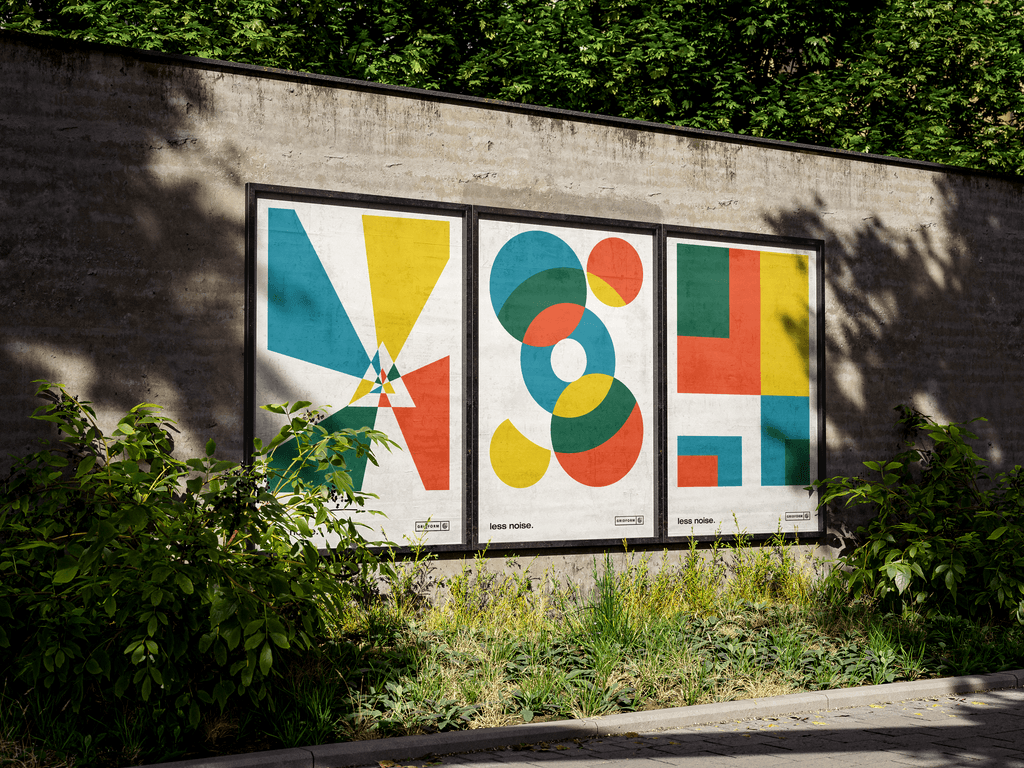
As digital spaces become increasingly saturated with content, color, and competing messages, the challenge of clarity grows more difficult and more important. Many brands attempt to solve this by adding more: more decoration, more motion, more variation. My design practice takes the opposite approach. Influenced by Swiss modernist principles, I believe strong design should begin with a minimal foundation. When a system is built on structure, hierarchy, and restraint first, it creates a framework that can later support expression, personality, and embellishment without losing its integrity.

Why design should start with less
A minimal approach does not mean empty or cold—it means intentional. By beginning with limited typefaces, simple layouts, and clear spatial relationships, the core function of the design becomes visible. The message is not buried under visual effects, and the hierarchy is immediately understandable. This stage is about solving the problem at its most basic level: Does it communicate? Does it guide the eye? Does it scale? When these questions are answered through structure rather than decoration, the design gains stability. Everything added afterward becomes a choice rather than a correction.
Minimalism as a foundation, not a finish
Minimalism is often treated as a final aesthetic, but in my process it functions as a starting point. Once a clear system exists—defined by grid, proportion, and typographic logic—it can evolve. Color, illustration, motion, and texture can be layered on top without compromising usability or coherence. Because the underlying framework is sound, personality becomes additive instead of compensatory. The design does not rely on embellishment to feel complete; embellishment becomes a way to amplify what is already working.
Building personality without losing clarity
When a design system begins with restraint, it creates space for personality to emerge in focused ways. A single accent color becomes more meaningful. A graphic gesture carries more impact. A moment of expression feels intentional rather than chaotic. This balance allows brands to feel both disciplined and human—structured enough to remain consistent, yet flexible enough to adapt across platforms and contexts. Instead of choosing between utility and emotion, the system supports both.
Why this approach matters now
In an environment dominated by visual clutter, starting from simplicity is a form of resistance. It prioritizes understanding and coherence over novelty and excess. For me, this modernist thinking is not about stripping design down permanently. It's about constructing a stable base so that complexity can be introduced with control and purpose. When clarity comes first, personality can follow without undermining the design itself.
.see also